

Kids Dental X-Rays: Risks, Benefits & Safety Guide
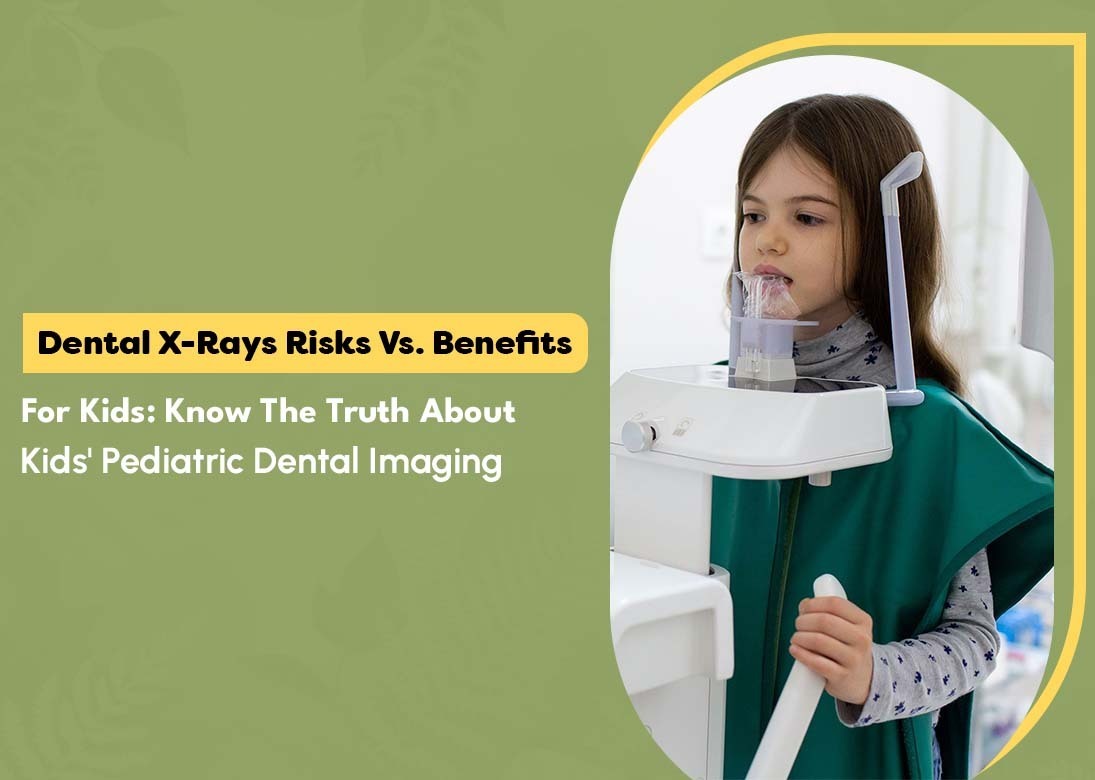
Parents are often concerned about their children undergoing a procedure involving imaging technique. Parents must know that pediatric dental imaging does not involve high radiations and if certain protocols are followed, it is a safe option to detect dental issues in children. However, despite various benefits of pediatric dental X-rays there sure is a minimal risk parents must be aware of.
When talking about dental X-rays for children it is important to understand the balance between minimal risk and maximal benefits.
This guide explores the current standards for pediatric dental imaging, the real numbers behind radiation, and the latest safety shifts that every parent should know.
Why Do Kids Need X-Rays?
Pediatric dental imaging is often a beneficial approach that can detect underlying issues that pediatric dentists’ naked eye also cannot detect. A child’s tooth might look perfectly white and healthy but can develop issues that may cause pain later and require invasive procedures.
Detecting Hidden Cavities
One of the several benefits of dental X-rays for kids is that they can detect cavities before they develop completely. Children’s teeth touch each other just like adults, and the space between is the most common site for decay. Significantly, baby tooth enamel is thinner than adult enamel, and thus, a cavity can travel to the nerve much faster. An X-ray detects these interproximal cavities months before they cause pain or require a root canal.
Monitoring Growth and Development
A pediatric dental imaging technique can assist in the tracking of the following developments:
Missing or Extra Teeth
Some children are born without certain adult teeth or with supernumerary teeth that can cause crowding. Pediatric dental X-rays for children can help detect these and timely assist with treatment options.
Impacted Teeth
Another of the benefits of dental X-rays for kids is that they can help monitor if adult teeth are coming in at the right angle.
Bone Health
Radiation exposure in pediatric dentistry can assist in early detection of infections, cysts, or abscesses that could damage the developing adult teeth underneath the gums.
Safety Protocols: The ALARA Principle
Pediatric dentists are meant to follow the ALARA (As Low As Reasonably Achievable) principle. This is because they know pediatric dental imaging is a specific clinical need and not just because it’s time for a check-up.
To minimize radiation risks in dental imaging, your dentist should:
Use Digital Sensors
These require a fraction of the radiation of traditional film.
Size-Specific Settings
Modern X-ray machines have a child setting that reduces dental X-ray radiation levels based on the child's body size.
Clinical Justification
The dentist should perform a physical exam first and only order X-rays if they see signs of risk (like tight tooth contacts or a history of cavities).
Do Kids Still Need Lead Aprons and Thyroid Collars?
One of the most significant shifts in pediatric dentistry occurred recently. In February 2024, the American Dental Association (ADA) updated its recommendations, suggesting that lead aprons and thyroid collars are no longer necessary for routine pediatric dental imaging.
Why the Change?
The following are a few reasons why radiation exposure in pediatric dentistry does not require lead aprons and thyroid collars:
Digital Sensors
Modern digital X-rays are 80-90% more sensitive than old-fashioned film, requiring much less radiation to get a clear image.
Rectangular Collimation
Dentists now use devices that shape the X-ray beam into a precise rectangle that matches the sensor. This means radiation risks in dental imaging are less with no scattered beams that may reach the rest of the body.
Better Imaging
The ADA found that lead aprons and thyroid collars can sometimes block part of the image. This leads to retake, which actually doubles the radiation exposure.
How Often Should Your Child Get X-Rays?
Dental X-ray radiation levels vary for each child. The frequency depends entirely on your child's caries risk assessment.
Low-Risk Children
If your child has no history of cavities, brushes twice a day, and has gaps between their teeth, they may only need pediatric dental imaging every 12 to 24 months.
High-Risk Children
If your child has a history of frequent cavities, poor oral hygiene, or a diet high in sugar, the American Academy of Pediatric Dentistry (AAPD) recommends imaging every 6 to 12 months to catch decay before it destroys the tooth.
In The End
Pediatric dental imaging is one of the safest methods for early detection of dental issues in children. This early intervention can save your child from dental issues that may be costly and require complex procedures. On the other hand, a small cavity that was left undetected can lead to pain, systemic infection, and the loss of a tooth. Therefore, specialized pediatric dentists recommend dental X-rays for children after a certain period of time, depending on the child’s caries risk factors.
Why Choose Little Forest Pediatric Dentistry?
Little Forest Pediatric Dentistry provides compassionate, family-centered dental care in a safe and welcoming environment. By partnering with parents and tailoring care to each child, we focus on education and trust to build strong, lifelong oral health habits. Our specialized pediatric dentists ensure each child feels confident while developing healthy habits that last a lifetime.
Frequently Asked Questions ( FAQs)
Q1. At what age should a child have their first dental X-ray?
There is no set age, but most children have their first X-rays between the ages of 3 and 4. However, once the back teeth (molars) begin to touch each other, a toothbrush can no longer clean between them, and a dentist can no longer see between them. This is usually when the first X-rays are taken.
Q2. How can I make the process easier for my child?
A parent can use child-friendly language, like calling the X-ray machine a magic camera that takes pictures of their tooth bones. In addition, the parents can have their children practice opening their mouth wide and holding very still, like a statue.
Q3. Can we just wait until my child has a toothache?
Waiting for a toothache usually means the decay has reached the nerve. At that point, the treatment is more invasive, like a pulpotomy or extraction. Parents must know that pediatric dental X-rays are designed to catch micro-cavities while they can still be treated with a simple filling or even reversed with fluoride.
Q4. Are dental X-rays safe for children?
Yes. Modern pediatric dental X-rays use very low radiation levels and are taken only when clinically necessary. Digital sensors and child-specific settings help reduce exposure while allowing dentists to detect cavities and other hidden concerns early.
Q5. How long does a child’s dental X-ray take?
Most children’s dental X-rays take only a few minutes. Digital imaging captures clear pictures quickly, helping reduce chair time and discomfort. The dentist can review the images right away and explain any findings or treatment needs to parents.



Frequently Asked Questions

Request an Appointment
Corona, California 92883